On This Page
Powered staplers have moved from a niche option to a mainstream choice in many hospitals. Manual staplers are still widely used and well understood. This article explains the difference, summarises what published reviews report, and suggests how to think about the choice.
How a Manual Stapler Works
In a manual stapler the surgeon’s hand provides the force. Squeezing the handle closes the jaws, and a second action fires the staples and, in a cutter, advances the blade. The speed and force of firing therefore depend on the person using it. A rushed squeeze can form staples differently from a slow, steady one.
How a Powered Stapler Works
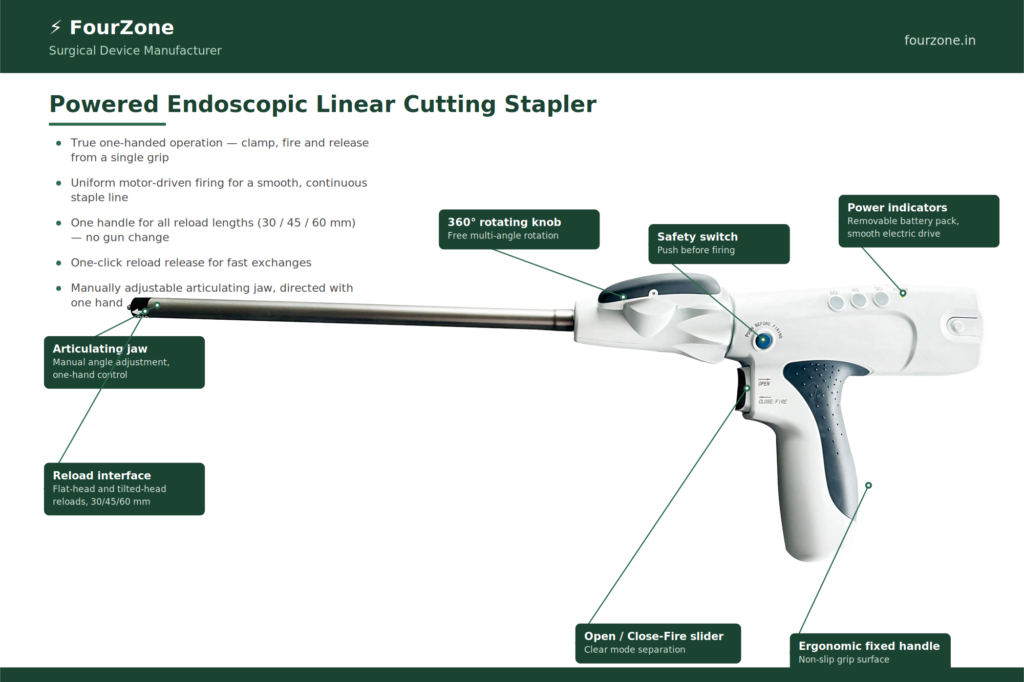
A powered stapler replaces the firing force with a battery-driven motor. The motor drives the cut and the staple line at a uniform rate on every stroke, which removes one source of variation. The surgeon controls when to fire, while the device controls how it fires.
The XYTE RAPF X is built on this idea: the motor takes the surgeon’s hand out of the firing force, and the device is designed for one-handed use with an ergonomic grip and manual articulation. XYTE also offers a powered or manual platform, TENZR GC, that takes the same reloads. See the XYTE Powered range.
What Do Published Reviews Say?
The evidence is mixed, and some of the strongest claims come from conference abstracts or manufacturer material, so read it with care.
- A 2023 scoping review and meta-analysis of 19 studies, presented at ISPOR, reported benefits for powered devices in operation time, hospital stay, anastomotic or air leak, and 30-day readmission. It found no significant difference in blood loss or in bleeding and transfusion.
- The same analysis found uneven results by device type. Powered circular staplers reduced anastomotic leak compared with manual ones, but powered linear and vascular staplers did not show a clear leak advantage.
- The authors concluded that higher-quality studies are still needed before firm conclusions can be drawn.
In short, there are signals in favour of powered devices in some settings, but the evidence does not yet support a blanket claim that powered is better than manual in every procedure.
Practical Points Beyond the Studies
Consistency
A uniform firing rate is attractive because it makes staple formation more predictable from case to case and from surgeon to surgeon.
Ergonomics
Powered firing reduces hand force, which can matter in long lists or for surgeons with smaller hands. Manual devices remain simple and have no battery to manage.
Cost and Supply
Powered devices often cost more per procedure. Hospitals should look at the whole picture: device cost, reload cost, training, and any clinical or operating-time benefits seen locally.
Training and Familiarity
A device the team already knows well often performs better than a new one used for the first time. Plan a short training and proctoring period when moving to powered platforms.
How to Decide
- List the procedures where you use staplers most.
- Check the evidence for those procedures, not only the overall figures.
- Pilot a powered platform alongside your current manual device and record simple outcomes.
- Compare total cost per case, not only the price of the handle.
Our stapler selection checklist covers these points in more detail. If you would like to see a powered platform for yourself, contact the XYTE team.
Who Might Benefit Most From Powered Devices?
Because the evidence does not support a blanket claim, it is more useful to think about where a powered stapler is likely to make a practical difference.
- High-volume lists where hand fatigue and variation between firings are a concern.
- Difficult access such as the low pelvis, where a stable head during firing is valuable and a surgeon may find it hard to apply steady force by hand.
- Training environments where consistent firing helps trainees reproduce a good staple line.
- Circular anastomosis where the meta-analysis noted a reduction in anastomotic leak with powered circular staplers.
Where Manual Staplers Remain a Good Choice
- Low-complexity cases where the difference in firing is unlikely to matter.
- Cost-sensitive settings where the budget does not allow a powered handle for every case.
- Locations where battery logistics are difficult.
- Surgeons with a strong preference for the tactile feedback of manual firing.
How to Run a Fair Comparison
Local data is often more persuasive than published studies. If you plan a pilot, define the comparison before you start:
- Choose one or two procedures with enough volume.
- Record the same measures for both devices, such as misfires, number of reloads used, theatre time and any intra-operative issues.
- Let more than one surgeon use each device.
- Review the results together after a fixed number of cases.
A short, honest pilot gives your team its own evidence, which is worth more than any brochure.
Continue Reading
- How to Choose a Surgical Stapler: A Checklist for Hospitals
- Staple Line Reinforcement: Why It Matters
- Open vs Laparoscopic Staplers: Differences and When Each Is Used
Frequently Asked Questions
What is a powered surgical stapler?
A powered stapler uses a battery-driven motor to drive the staples and, in a cutter, the blade, so firing speed and force are the same on every stroke.
Are powered staplers better than manual staplers?
Published evidence is mixed. A 2023 meta-analysis reported advantages in some outcomes for powered devices, but not for every type of stapler, and its authors called for higher-quality studies.
Do powered staplers need special reloads?
It depends on the platform. Some powered platforms accept the same reloads as their manual versions.
Sources
Scoping review and meta-analysis on powered and manual staplers: ISPOR 2023 presentation.